
Offset vs Redraw: What’s the Difference?
Both an offset account and a redraw facility let you use extra cash to reduce the interest you pay on your home loan. They can look similar on the surface, but they work quite differently — and picking the right one (or the right mix) can matter for your tax position, your flexibility, and how you actually behave with money.
How an Offset Account Works
A 100% offset account is a separate transaction account linked to your home loan. Any money sitting in it “offsets” the equivalent amount of your loan balance for interest calculation purposes — but the money itself stays completely separate from the loan.
Example (illustrative only): if you have a $500,000 loan and $30,000 sitting in your offset account, you’re only charged interest on $470,000. Your everyday salary can land straight into this account, effectively reducing your interest daily, while you still have full and instant access to the funds via your card or transfers — just like a regular bank account.
How Redraw Works
A redraw facility lets you make extra repayments directly onto your loan, reducing the principal balance (and the interest charged) — with the option to “redraw” those extra funds back out later if you need them.
Unlike offset, the extra money isn’t sitting separately — it’s actually paid into the loan. Getting it back out usually involves a request to your lender, and depending on the lender, this can take anywhere from an instant transfer to a few business days, and some lenders cap how much or how often you can redraw.
The Key Differences
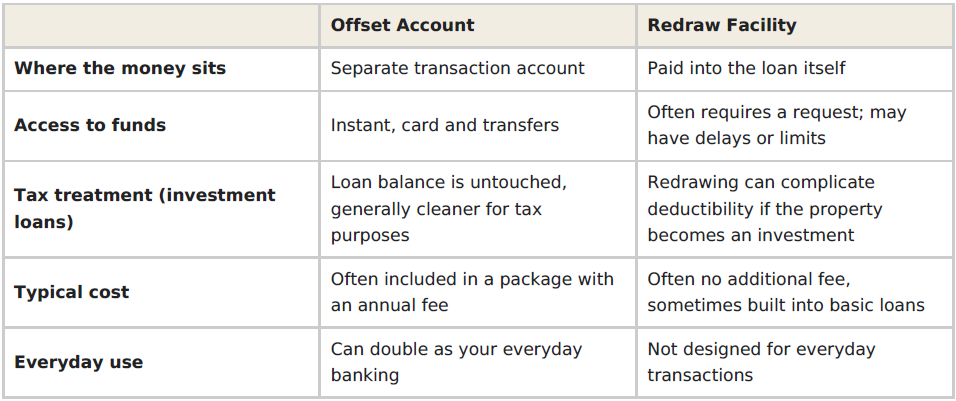
Why the Tax Treatment Matters
This is the detail that trips a lot of people up, particularly if there’s any chance your home could become an investment property down the track. If you redraw funds from your loan for a private purpose (a car, a holiday, renovations to a different property), the ATO generally treats that portion of the loan as no longer deductible if the property later becomes a rental — because the purpose of the borrowing has changed. Money sitting in an offset account, by contrast, never actually reduces the loan balance, so it doesn’t create this same tracing problem.
If tax deductibility could ever be relevant to you, this is a conversation worth having with your accountant or tax agent before you decide — we’re not tax advisers, but we can make sure your loan structure keeps your options open.
Which One Should You Choose?
For most owner-occupiers who want everyday flexibility and might one day rent out their home, a 100% offset account is usually the more flexible option — even though it can come with a small annual package fee. For a straightforward owner-occupied loan you never intend to turn into an investment, a no-fee redraw facility can achieve a very similar interest-saving outcome at a lower ongoing cost.
Some loans offer both — letting you use an offset for your everyday savings buffer, while still making extra repayments you can redraw for planned larger expenses later.
Get the Structure Right From the Start
The right structure depends on your goals, whether the property could become an investment, and how disciplined you want your banking to be. We’ll walk you through the right setup for your situation.
Get Started and let’s structure your loan properly from day one.
This article is general information only and does not take into account your personal financial situation, needs or objectives. It is not personal financial, credit, or tax advice, and nothing here should be relied on for tax planning purposes — speak with a registered tax agent or accountant about the tax treatment of your specific circumstances. The information provided on this site is on the understanding that it is for illustrative and discussion purposes only. Whilst all care and attention is taken in its preparation any party seeking to rely on its content or otherwise should make their own enquiries and research to ensure its relevance to your specific personal and business requirements and circumstances. Terms, conditions, fees and charges may apply. Normal lending criteria apply. Rates subject to change. Approved applicants only. Spitfire Finance Pty Ltd ABN 70 700 362 956, ACN 700 362 956 is authorised under LMG Broker Services Pty Ltd ACN 632 405 504 Australian Credit Licence 517192.